


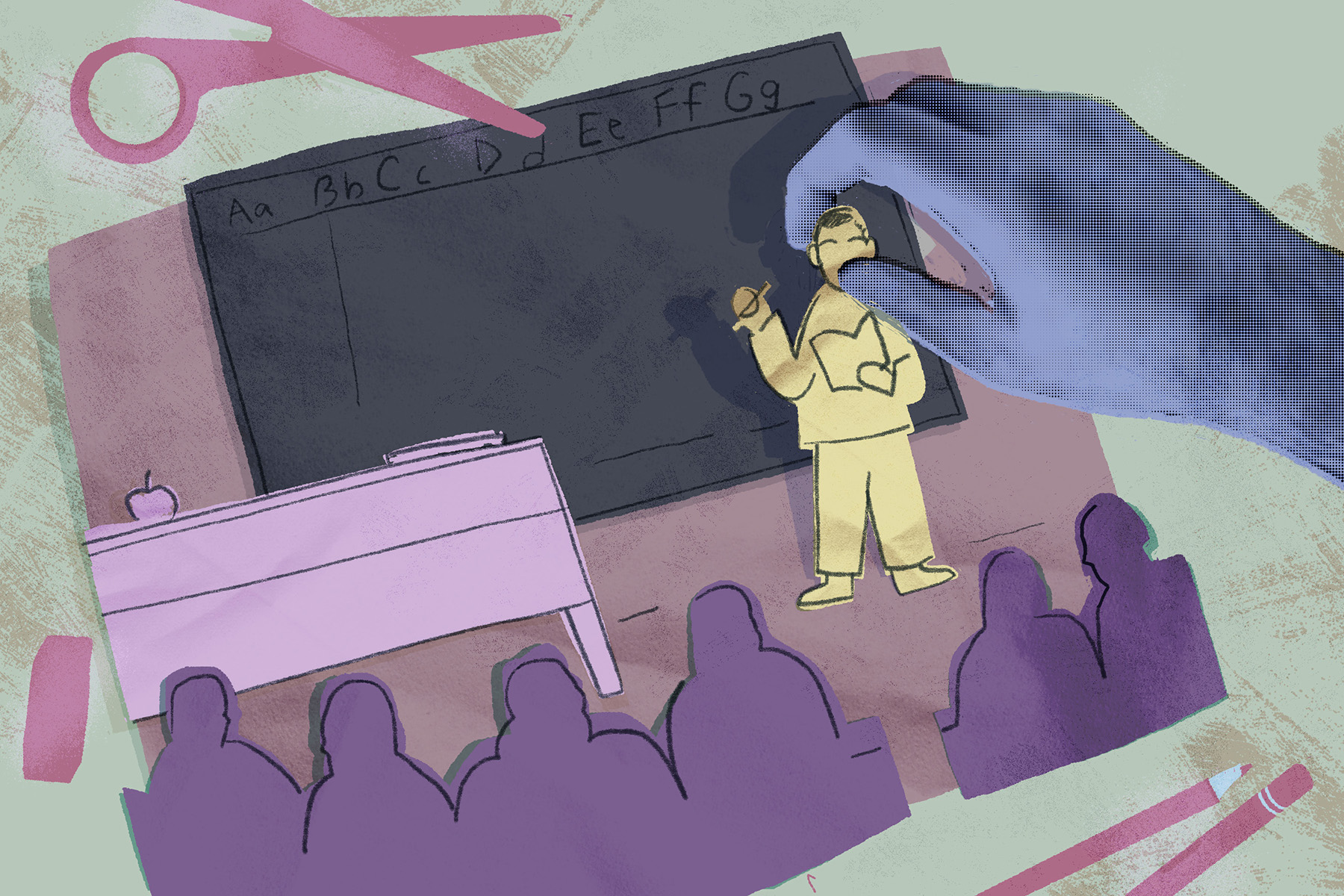
Since the COVID-19 pandemic, the Toronto District School Board (TDSB) has recorded a massive surge in its reliance on people who aren’t qualified teachers to fill in for school staff. But exclusive data obtained by The Local shows certain schools in the city—particularly those in low-income neighbourhoods—are disproportionately depending on non-teachers to cover staff absences or vacancies, with some schools using them more than 1,000 times in a single academic year.
Previously, The Local reported that the TDSB’s use of non-teachers, known as emergency replacement people, had increased by a staggering 1,152 percent in the seven years since 2017-18. But additional records, obtained from the board through a freedom of information request, provide more granular data, showing the number of times each school used emergency replacements for every school year from 2017-18 to 2024-25.
In 2017-18, just 243 of the TDSB’s nearly 600 schools used emergency replacements, many of them only once or twice. But by 2024-25, 474 were relying on these non-teachers, often hundreds of times each school year.
An independent analysis by The Local found that schools in some of the least affluent areas of the city are now using non-teachers the most. The ten schools with the highest usage in 2024-25 were in neighbourhoods where the median household income was less than $70,200, well below the citywide median of $84,000.
Topping the list were Valley Park Middle School, Gateway Public School, and Thorncliffe Park Public School—all serving students in Thorncliffe Park and Flemingdon Park. In 2024-25, these schools used emergency replacement people more than 1,000 times, with Valley Park Middle School recording the highest use at 1,506 times. In the Scarborough Junction neighbourhood, Corvette Junior Public School used non-teachers 1,004 times. These schools all have large student populations and are “Model Schools for Inner Cities,” a designation that provides extra support to TDSB schools in under-served communities. According to the government of Ontario’s School Information Finder, each of these schools has a sizable proportion of students living in lower-income households, whose first language is not English or French, and who are new to Canada from a non-English or non-French speaking country.
Schools with the highest use of non-teachers also tended to have the smallest proportion of gifted students.
By comparison, The Local identified at least 100 schools—some of them similar in size to Corvette Junior or larger, like Forest Hill Junior and Senior Public School or Rockford Public School—that were not listed as having used non-teachers at all in 2024-25. It’s difficult to say what accounts for the disparate use of non-teachers. The board did not respond to our questions. But the data makes clear that students in low-income neighbourhoods are the ones affected most.
Emergency replacement people are meant to be called upon to teach only as a last resort. Under the provincial Education Act, the only requirement is that they be 18 years of age or older, and have a high school diploma or equivalent. The TDSB has its own additional requirements. To be an emergency replacement at the board, an individual must be a non-teacher who has been screened and interviewed, and has submitted a police reference check to the TDSB. Often, they’re school lunch supervisors, or parents or guardians who volunteer at the school. Some are aspiring teachers who are not yet certified.
When The Local previously reported on this issue last year, the TDSB said the dramatic increase in its use of emergency replacements was attributed to teachers’ use of sick leaves, including sick days and long-term absences for illnesses, and a shortage of available occasional teachers, also known as supply teachers. When a teacher is away, a board spokesperson explained, administrators first look to fill the opening from the TDSB’s occasional teacher roster, a fluctuating list that included nearly 3,700 elementary and 1,700 secondary teachers in June 2025. If that spot can’t be filled with an occasional teacher, the principal looks for other staff in the school to see if they can help. And when they aren’t able to do that, they bring in an emergency replacement.
The TDSB said it’s not always possible to obtain occasional teachers since they have the flexibility to choose when and where they work. That means they’re able to turn down jobs depending on their preference. (While long-term occasional positions are posted on the TDSB’s website, short-term jobs are sent to the board’s roster of supply teachers through automated phone calls, which let recipients accept or deny the job.) They’re also able to work for multiple school boards, the TDSB said, and often pick up long-term occasional positions at other boards, which tend to be more desirable than single day or half-day jobs.
It’s uncertain, though, why some schools in the city are relying on emergency replacements far more frequently than others. The TDSB did not provide an official response to multiple requests by The Local for comment for this article. Since the province placed the board under its supervision last June, the TDSB has sometimes referred our requests to the Ministry of Education. The Local’s emails to the ministry and the minister’s office went unanswered.
It’s possible that in some cases, a school’s location, with poor access to public transportation, may deter supply teachers from accepting a job. A negative experience at a particular school could make a supply teacher stay away the next time a job comes up there.
Marisa Gallippi, president of the Toronto occasional teachers’ local of the Elementary Teachers’ Federation of Ontario (ETFO), declined to speculate on why the usage of non-teachers varies between schools, or why occasional teachers may accept or decline specific jobs. However, she said, working conditions, available supports, and overall staffing practices play a significant role in creating environments where educators can most effectively do their jobs and students can thrive.
The frequent use of non-teachers “has a significant impact on student outcomes, placing both academic progress and student safety at risk,” Gallippi said.
There are other factors that may skew the data, suggested Stacey Cline, the elected trustee for Ward 11—Don Valley West. (Cline said she could not speak in her official capacity as a trustee, since all TDSB trustees were stripped of their roles when the province placed the board under its supervision. However, she agreed to be interviewed as a former teacher with the TDSB.)
Based on her past experience teaching, Cline said there are lots of reasons why a school may suddenly need to cover a large number of staff absences, from professional training conferences to outbreaks of highly contagious illnesses, like norovirus. The data obtained by The Local is not able to capture these anomalous surges. Our data also only goes up to the end of the 2024-25 school year, and therefore does not show whether new policies, implemented by the TDSB in September to reduce teacher absences, have had any effect.
Cline said she knew of no reason that occasional teachers would decline jobs in lower-income areas in particular. Having previously enjoyed teaching in an underserved neighbourhood in the Jane and Finch area herself, she said, “I would never suggest that people are specifically avoiding that area, because I personally could not even imagine it.”
She added the data should be interpreted with caution, since it doesn’t capture the nuances that may explain the vast differences between schools’ use of emergency replacements.
Don't Miss Out
Stay up-to-date with our School Board Takeover series by signing up for our free newsletter.
"*" indicates required fields

David Mastin, the president of the ETFO, said the use of non-teachers in classrooms is “incredibly discouraging.” To become a teacher, one must have four years of post-secondary education, plus complete a two-year teacher training program.
Teaching is not simply a matter of “saying, ‘I’m good with young kids, therefore I can do this.’ This is a profession, and as such, there’s a high degree of training that’s involved,” Mastin said. “I can’t imagine what quality of program is being delivered by someone who hasn’t got that training—it would be a catastrophe for students.”
While the ETFO had a recent internal task force that examined the use of emergency replacements, Mastin said, he could not share its outcome or decisions. He also said he didn’t have any data to explain why certain schools used non-teachers more than others, but the issue was something they were following closely.
A number of his union’s occasional teacher members were waiting around for work, he said, adding that he wondered whether principals may be calling on non-teachers as a cheaper alternative to occasional teachers, amid efforts to reduce school board spending, particularly during the province’s supervision. He emphasized he did not have evidence to claim that is, in fact, happening. The Local also could not independently find support this is the case. “But it’s a possibility, and it’s something that we need to be watching extremely carefully,” Mastin said.
Emergency supply people are paid about $142 per day, while occasional teachers earn between $250 to $300 a day.
Brittany, an occasional teacher, said she is struggling to find sufficient work at the TDSB. She is using a pseudonym because she is not authorized by the board to speak to the media. As a certified teacher who has been working as an occasional or long-term occasional teacher for the past ten years, she accepted a long-term occasional job at a TDSB school earlier this school year. The job wasn’t ideal—it was only part-time instead of full-time, but Brittany took it anyway after she was assured there’d be plenty of opportunities to pick up part-time supply jobs to fill her free mornings. That has not panned out, however. Since September, she said, she’s only received about six calls to fill morning positions. At the school where she’s currently working, she often receives emails saying a teacher is away, and the person filling in for them is the lunchtime supervisor, even when that job is only for the morning.
“I’m free in the morning. I’m a certified teacher, and I know that we have a list of certified teachers hoping to get called to our school,” she said. “And so that’s odd” that non-teachers are getting those jobs.
For some reason—Brittany isn’t sure why—she’s received far fewer calls for supply jobs this school year than in past years.
At the same time, she said she’s noticed a marked increase in the use of emergency replacement people at her school from last year. Some of them really should be certified teachers, she said; “They do a great job.” But others often fill the day with extra outdoor time or interactive YouTube videos.
As a parent of a young TDSB student, she said the use of non-teachers is cause for concern, especially if they’re being used to cover a homeroom teacher who’s away frequently. “It makes me worry, like as a parent, for how that’s setting my daughter back further academically,” she said.
In December, Education Minister Paul Calandra announced he was appointing a new advisory body to assess student learning, in a bid to strengthen student achievement. His announcement came amid the province’s unprecedented takeover of multiple school boards—now eight of them, including several of Ontario’s largest—and impending plans to reform school board governance. But while the minister said he is aiming to improve student outcomes, it’s unclear if and how he intends to address the fact that schools in underserved areas of the province’s biggest board now routinely rely on people who aren’t trained or certified to teach. The use of emergency replacement people was not specifically mentioned in the province’s description of the role of its new advisory body. The ministry and the minister’s office did not reply to The Local’s repeated requests for answers.
_____________
Data collection by Wency Leung, Xavi Richer Vis, and Tai Huynh; analysis and visualization by Tai Huynh.
More from this issue

The State of Toronto Schools A Year After the Ford Takeover
The province promised to fix public education. A year after unprecedented takeovers, it’s delivered less transparency, cuts to programs, and deeper uncertainty for the students who need the most support.

The Province Took Over Ontario’s Biggest School Boards to Fix Their Finances. The Numbers Tell a Different Story
Analysis by The Local shows Ontario’s largest boards receive some of the lowest per-student funding in the province—raising questions about whether the real problem is mismanagement or the funding formula.

“It’s Quite Clear They Don’t Listen to Us”
For years, the TDSB's special education advisory committee has pressed for accountability from the board. Since the province's takeover, that's become harder than ever.

What Happens to TDSB’s $20 Billion Worth of Land Under Provincial Supervision?
The Toronto District School Board is one of the city’s largest landowners. When the province took over the board, it also took over its subsidiary that manages its properties—and it’s not saying what’s next.

New Data Shows Dramatic Rise in Non-Teachers Filling in at TDSB Schools
Records obtained by The Local reveal the Toronto District School Board’s use of unqualified emergency replacements jumped more than 1,100 percent since COVID.

Takeover of GTA School Boards—Your Questions Answered
What we know about the province’s supervision of GTA school boards, so far.
Inside the Takeover of Toronto-Area School Boards
The province says its decision to put multiple school boards under supervision is about restoring financial stability. But observers see a larger play for power.