
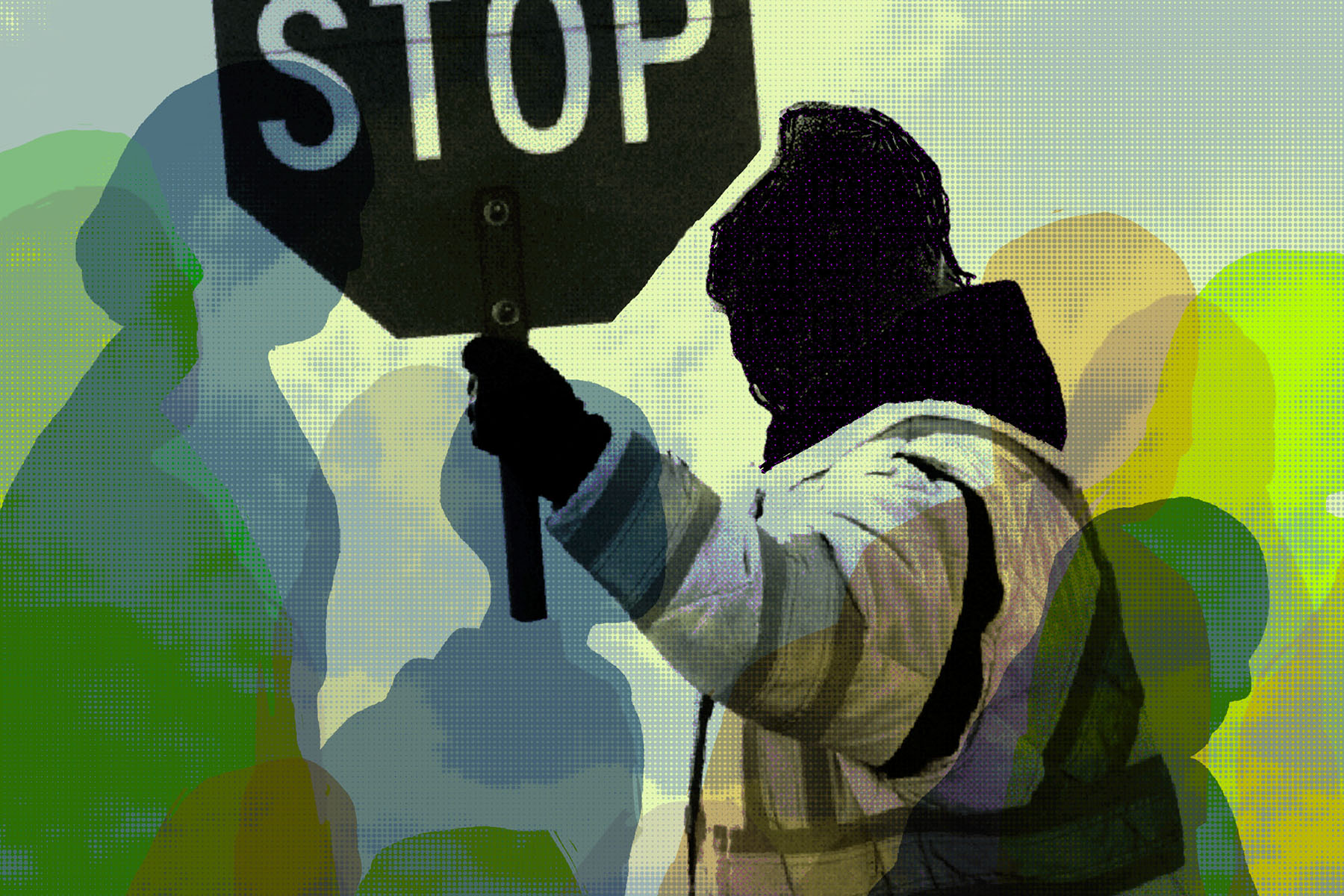
The first time Matt Hallowell was punched in the face during his tenure as a Toronto crossing guard, it was by a bicyclist who’d blazed by, cutting between him and the pedestrians he was escorting across the street. Hallowell yelled out something about respect, and before he knew it, the bicyclist had thrown down his bicycle, stomped back to the crosswalk and “Pow! Drilled me one right in the face.”
“I’ve never been punched in the face before,” Hallowell says, rubbing at his stubbled salt-and-peppered chin as he recalls the moment of being knocked off his feet in the middle of his shift. A young pedestrian had stepped in to defend Hallowell as the assailant geared up for another blow, crying out, “He’s an old man!” (The characterization caught Hallowell off-guard almost as much as the punch itself.)
Hallowell is an admittedly youthful 66, with small glasses on an earnest face sporting a magnificent mustache that curls at the ends. He served as a crossing guard at Parliament and Shuter Streets in Cabbagetown between 2020 and 2025. He had taken up the work when COVID-19 and the lockdowns made his job as an occupational therapy assistant impossible, and left him looking for ways to connect with his community. “I’m kind of an outgoing person. I need to speak to people and see people,” he says. His chuckling, jovial demeanour is almost dismissive of the harassment he has faced doing a job he loves.
All it took was a chat with a neighbourhood crossing guard, a vulnerable sector check, and a single day of training before Hallowell was on the corner, ready to guide his community to safety. He is one of hundreds of crossing guards who work alone at some of the city’s busiest intersections, public spaces where traffic, stress, and social strain collide. Though Hallowell was the only one who would speak on the record, The Local interviewed several other Toronto crossing guards who spoke anonymously about the increase in badly behaved drivers and verbal harassment from pedestrians since the pandemic.
“$17.32 an hour,” Hallowell says, shaking his head incredulously, “for stepping in front of moving vehicles with a whistle and a stop sign.”
The very conditions that have intensified the need for crossing guards on Toronto’s densely populated streets, like rising rates of assault and speeding, have also contributed to the work being more precarious than ever. Just this week, a crossing guard in Ottawa died after a hit and run incident near an elementary school. And while other public servants derive authority from uniforms, or weapons, or institutional power, crossing guards rely largely on social custom and goodwill. Historically, the role was filled by either police or beloved elder members of the community who volunteered at schools; today, that continues to be how most people envision the role. But in reality, many crossing guards are new immigrants and contract workers who don’t actually live in the area, and are asked to absorb risk on behalf of the local community—to manage conflict, to keep children and seniors safe—all without the protections or compensation typically afforded to people tasked with public safety.
Join the thousands of Toronto area readers who've signed up for our free newsletter and get award-winning local journalism delivered to your inbox.
"*" indicates required fields
The role of the crossing guard in Toronto is nearly as old as that of the car. As cars became more popular following the first World War, collisions with pedestrians increased, so much so that in 1920 and 1928, Toronto city councillors sought to “ban motor vehicles on streets where children played,” according to an article by Brock University professor of geography Phillip Gordon Mackintosh. As Mackintosh writes in his book, Newspaper City, “Parents in 1920s Toronto knew the perils that traffic posed for their children, but allowed them to cross busy streets unaccompanied anyway.”
Those council motions went nowhere. So when the City couldn’t ban cars, it inserted people between vehicles and pedestrians.
Before adults were hired to ferry children across the street, that role was filled by volunteer students, trained by companies like the Canadian Automobile Association (CAA), which started a school safety patrol program in 1929.
Starting in 1947, the Toronto Police Force, as it was then called, took on the crossing guard service in this city, hiring and training civilians as part-time staff. City Council voted for their administration of the program to wind down in August 2019. The move seems to have originated from a 2011 KPMG report that looked at areas where the Toronto Police Service (TPS) could cut their budget and focus on “core” police work; the crossing guard service was placed in the “low” savings column. According to former city councillor Kristyn Wong‑Tam, now MPP for Toronto Centre, the TPS was eager to divest themselves of the program—that recommendation was then mentioned in the 2018 The Way Forward Action Plan from the TPS that eventually led to the council vote the same year.
The role of the crossing guard shifted from a job backed by institutional authority and benefits to contract work carried out largely alone.
“Back in the old days, before it was privatized, when a crossing guard called in sick, or if there was an issue, we’d send a police officer, and that police officer would handle crossing guard duties for the day,” explains Sean Shapiro, a former TPS officer. “And then that went away. Because it was privatized, the City thought they were going to save a whole bunch of money.”
City council moved the $7.525 million budget from the TPS to the City’s Transportation Services to be contracted out starting in 2019. Today, in North York, crossing guard contracts now belong to Carraway, a company “specializing in road safety and parking management.” In the south of the city and East York, the service is run by private security company Synergy. But the savings that were supposed to come with privatization have not materialized. Between 2017 and 2024, the number of locations with crossing guards went up 46 percent. But the budget in that time ballooned by 300 percent, reaching $30 million annually. Don Valley North councillor Shelley Carroll and former Scarborough—Rouge Park councillor Jennifer McKelvie proposed a review of the program by the City’s Transportation Services in late 2024 that has yet to be delivered.
Despite the inflated budget, all of the crossing guards The Local spoke with report not having life insurance coverage through their jobs. Two, who joined the Synergy workforce within the past 12 months, say they’ve never been covered; three, who have spent longer with Synergy and Carraway, say they lost their insurance in the past two years. Hallowell says that around the same time, the guards were given a 25 cent increase to their hourly wage. “Which, of course, will pay for insurance,” Hallowell says sarcastically. “Guards are paid like shit.”
Kim Hefferman, national director of Synergy’s crossing guard service, did not confirm how much Synergy’s crossing guards are paid, but said they were compensated “in accordance with the City of Toronto’s Fair Wage Policy for Crossing Guards.” When asked about the expanding budget for crossing guard services, she said that there are “a multitude of factors that contribute to the variance in cost of managing the program today vs years past.” She declined to comment on their insurance coverage, saying the company could not disclose specific details of a contract made with the City. In an email, Andrea Ramos, program administrator at Carraway, confirmed their crossing guards do not have insurance. When asked about the city’s growing budget for crossing guard services, she said there were no rising costs relating to Carraway’s operations which would explain the increase.
About 550 crossing guards work for Synergy in Toronto at almost 400 locations in the city, according to Hefferman. Some of those locations are known to be busier and less safe than others, according to both crossing guards and pedestrians.
“For the 2024-25 school season, we had 95 incidents of either injuries at work or near misses” involving crossing guards and vehicles, Hefferman says. But in the first three months of the 2025-26 school year alone, there were 56.
Even though she encourages crossing guards to report every incident, Hefferman thinks the numbers are underreported, because it’s hard to chase down things like license plates when your primary concern is keeping the children on your watch safe.
“$17.32 an hour… for stepping in front of moving vehicles with a whistle and a stop sign.”
The corner where Hallowell crossed back and forth carrying his red “lollipop” stop sign, ferrying kids, parents, seniors, and neighbours for five years, sits between four schools : St. Paul Catholic, Liberty Prep School, École élémentaire Gabrielle-Roy, and Nelson Mandela Park Public School, in the east end of downtown Toronto.
“When you’re in the downtown area, [the crossing guard] takes on a different role,” says Alyson Sobol, principal of five years at St. Paul Catholic. Sobol describes incidents where the school’s local crossing guard had to intervene when someone was acting aggressively toward students and parents, or suffering from what she suspects are drug-related or mental health issues. She’s familiar with Hallowell and his old corner—it’s a “convergence of people all with their own daily struggles,” she says. In 2025, reported assaults in the neighbourhood were up 15 percent compared to the year prior, according to TPS data.
The assault that knocked Hallowell off his feet was extreme—Hefferman says she counts very few violent incidents in the past two years. But the job of a crossing guard is built around managing risk in real time, for themselves and for others, with a limited ability to control anyone else’s actions. “Most crossing guards, they’re just superheroes,” Hefferman says. “They take it in stride and usually come back to work.”
“You’re first out there in front of the moving cars, hoping they’re going to stop,” Hallowell describes. Most cars and bikes do just that, they stop, whether grudgingly or courteously, according to both Hallowell and Synergy. Overall, car confrontations tend to far outnumber people confrontations, in Hallowell’s experience. “I’ve had cars so close to me that I can feel the heat from their engines on the back of my legs.”
He describes one encounter with a driver who, forced to wait for the pedestrians to cross the street, shouted insults at Hallowell; finally, the driver yelled, “When I can turn right, I’m going to park my car, I’m going to get out of it, and I’m going to come back here and beat the fucking shit out of you.”
“And I said, ‘I’ll be here, sir,’” Hallowell chuckles, describing that heated conversation from the cozy safety of a coffee shop. Three local acquaintances stepped in, offering to take care of the situation, and went over to speak to the irate man getting out of the now parked car. “I have no idea what they said to him,” Hallowell says, but the man got back in his car and left.
Crossing guards are supposed to keep others safe—but “it’s like putting the oxygen mask on you first,” Hallowell says. “If you don’t stay safe, who else is going to be able to stay safe?”
Shapiro, formerly of the TPS, says that if there weren’t a crossing guard at the crosswalk between his house and his kids’ school, he wouldn’t let them walk home by themselves. At some of these intersections, “nobody is driving the right way,” he says. “Otherwise, you wouldn’t need someone to intervene.”
Synergy crossing guards receive just one day’s worth of training before entering the role. This includes three hours of online course work, Hefferman says, and a written and practical exam. On this day, they’re trained in part on non-confrontation and de-escalation.
“I know it’s as simple as stop and go, but some people just don’t like being told what to do,” says Shapiro. “They don’t. And [crossing guards] become easy targets for the world’s frustrations.”
Hefferman says Synergy works to keep crossing guards safe, starting with reporting incidents, working with the supervisors, and offering to relocate crossing guards who have dealt with incidents in their work. But she’s also concerned that recent changes could make the work even less safe. In November 2025, Doug Ford’s government banned speed enforcement cameras across the province, calling them a “cash grab.” Hefferman points to a 2025 CAA study where 73 percent of drivers reported slowing down when approaching the speed camera, and 52 percent said they’re unlikely to speed up after passing through an Automated Speed Enforcement (ASE) zone. “There is proven data that shows that [the speed cameras] reduce incidents in school zones,” says Hefferman.
Local Journalism Matters.
We're able to produce impactful, award-winning journalism thanks to the generous support of readers. By supporting The Local, you're contributing to a new kind of journalism—in-depth, non-profit, from corners of the GTA too often overlooked.
SupportHallowell quit the job he loved after being assaulted twice in 14 months. The cyclist who allegedly punched him the first time was arrested on the spot by nearby police officers, and Hallowell testified in court in a case that ended in the charges being dropped. The second assault was from a man who demanded to know what authority Hallowell had to be blowing a whistle and holding a stop sign.
The faces of crossing guards have changed over the years, with younger people and visible minorities stepping into the role. Hallowell wants to see a return of the respect the job once garnered from the public.
For people like Sobol, the St. Paul principal and a parent herself, that respect already exists. She calls her crossing guard “an integral part of our community.”
Hallowell fondly remembers the people who would change their route so they could walk across the street with him. He remembers telling silly dad jokes to his regulars. “I miss those micro-relationships,” he says. Sometimes, he thinks about going to stand at his usual corner just to say hi, even with no authority whatsoever.
More from this issue

For Kids With Special Needs, Summer Camp Is Out of Reach
Few camps in the GTA serve children with developmental disorders or disabilities, forcing parents to take time off work to stay home and depriving kids of the chance to explore, play, and interact with their peers.
Gearing Up for October’s Municipal Elections
We are building a civic newsroom unlike any other, with an expanded scope to serve residents of not just Toronto, but also Mississauga and Brampton.
The New Chill Facing Trans Health Care
As anti-trans rhetoric intensifies at home and abroad, the organizations providing training in trans-inclusive healthcare say they’re seeing less uptake from physicians across Ontario.

The Local Wins Six National Awards
Our journalism took home top prizes at the National Magazine Awards and Canadian Association of Journalists Awards.

An Ancient Past Unearthed by Urban Construction
In 2024, an Indigenous burial site was found during construction on Withrow Avenue, near Riverdale Park East. Where others see a “hole” in the ground awaiting investigation, journalist Gabrielle McMann sees a window into Toronto’s complex pre-colonial history—and a deeper sense of belonging.
The Long Last Days of Toronto’s First Safe Consumption Site
Nick says he’ll go back to Manitoulin. Texas can’t even think about the closure. Inside Moss Park in the final days of a nine-year era of safe consumption.

The Local Expands Into Peel
Introducing Prarthana Pathak, our new Peel Reporter
The Local is Nominated For Ten More Journalism Awards
The nominations at the Digital Publishing Awards and National Magazine Awards recognize our journalism in 2025.

When Refugees Can’t Afford the Care They Need
New federal cuts to Canada's refugee health program take effect this week. The people who work with asylum seekers say the consequences could be devastating.

The Local is Nominated for Four Canadian Association of Journalists Awards
The awards recognize our in-depth reporting on everything from school boards to international students to AI to worm harvesting