
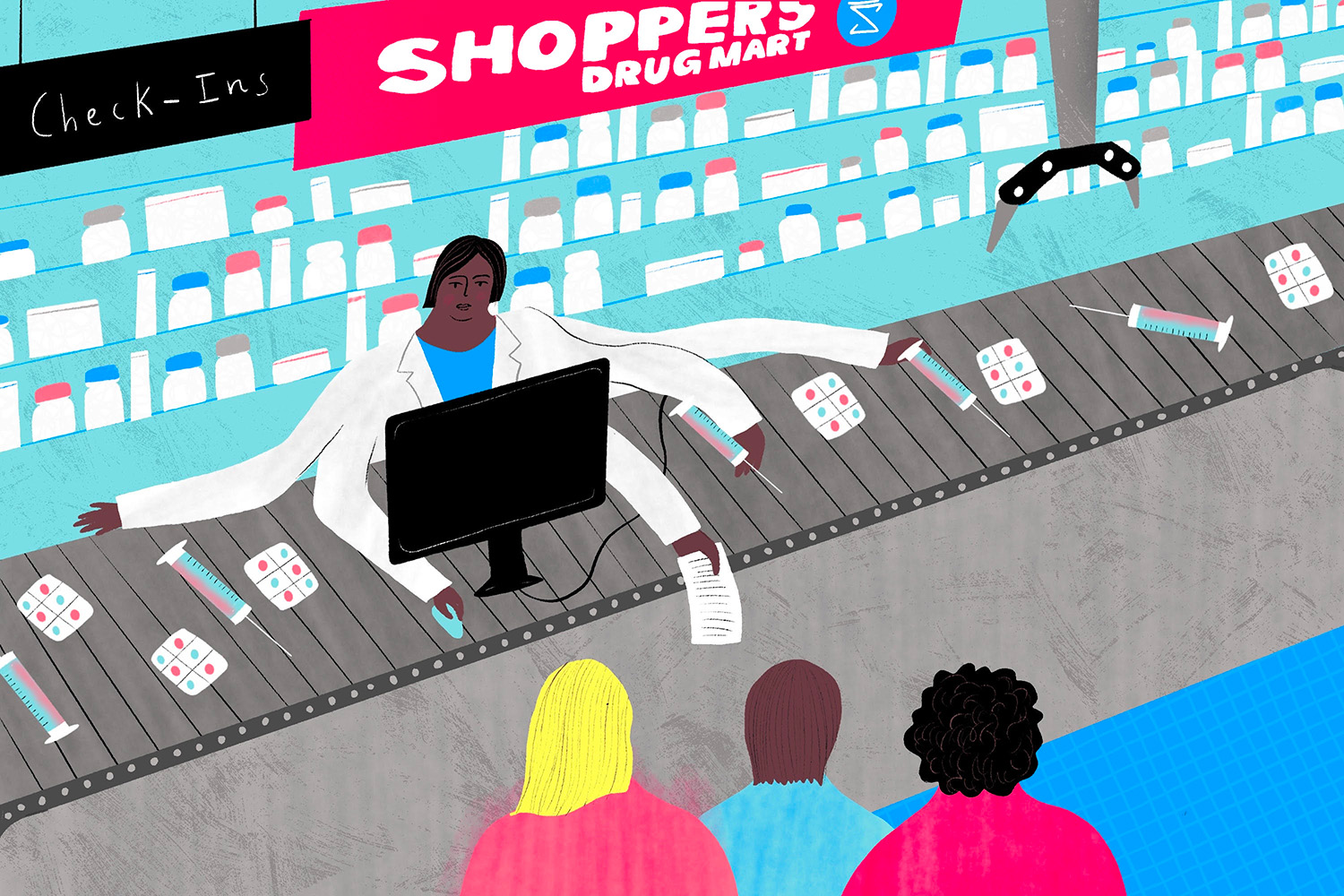
The first thing you need to understand, says Michael, is that “there’s not actually a lot of money to be made from selling medications.”
Every time a pharmacist dispenses a particular medication, they earn a nominal dispensing fee. At the Shoppers Drug Mart in Alberta where Michael worked as a pharmacist until 2020, this fee was around $12. (The Local has granted Michael a pseudonym due to concerns of professional reprisal.)
The remainder of a pharmacy’s revenue comes from a combination of retail sales and services like medication reviews, minor ailment assessments, and administering vaccinations. This revenue is what pays for a pharmacy’s salaries and business assets. And like other corporate pharmacies, Shoppers has faced allegations of setting sizable performance targets for its pharmacy teams in the interest of generating more revenue.
At the Shoppers Drug Mart pharmacy where Michael worked, he says his team would get “constant reminders about how we’re doing this week, what we have to do to hit a certain target within our pharmacy districts.”
In reporting on the sector by the CBC, and in a subsequent survey by the Ontario College of Pharmacists (the provincial regulator for the profession), workers at corporate pharmacies including Shoppers have described being instructed to provide a certain number of services, regardless of their value or medical necessity to patients.
Never Miss a Story
Sign-up to our free newsletter to receive the next story in the Cost of Care issue—publishing throughout January and February 2026.
"*" indicates required fields
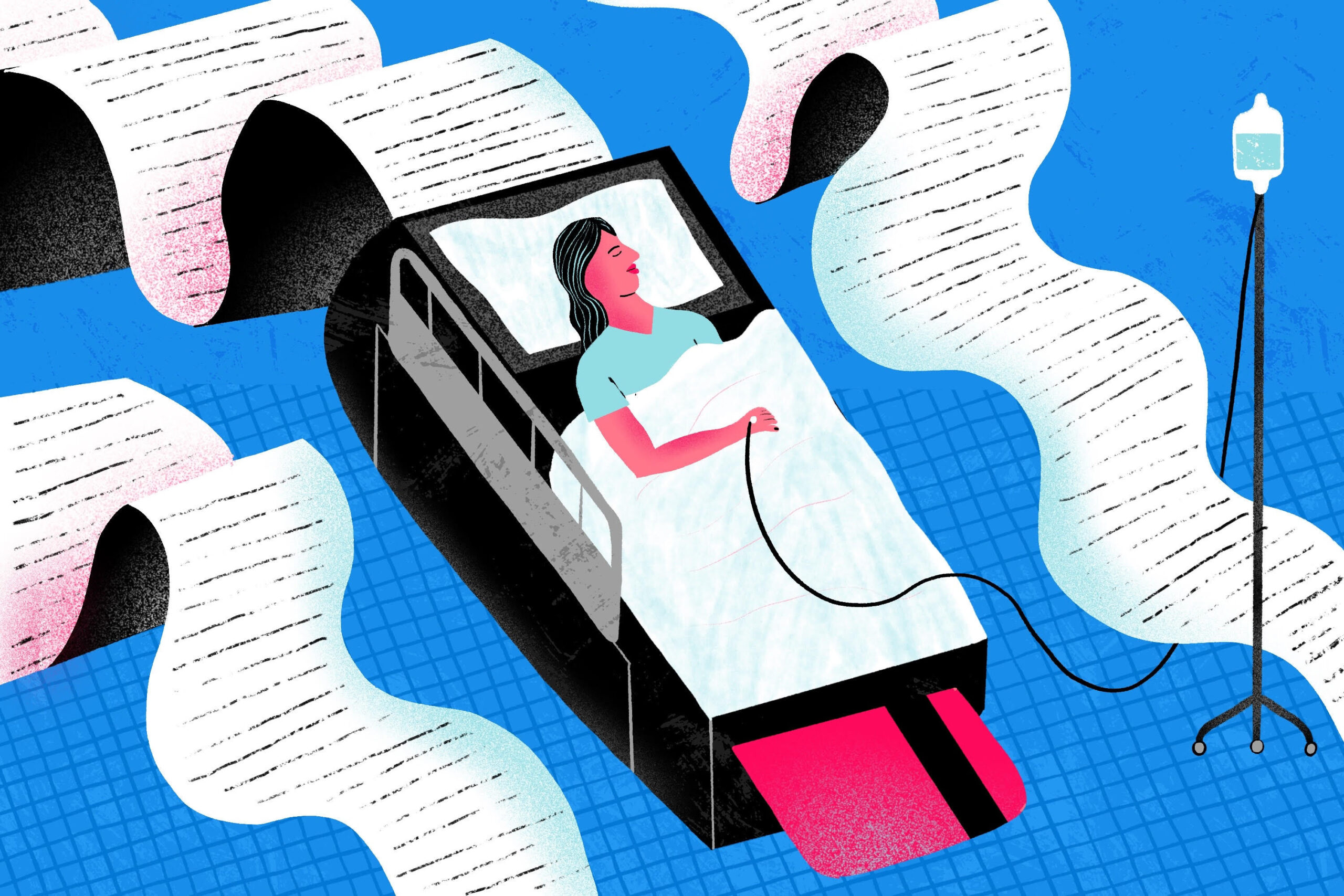
As per provincial legislation, pharmacies have to be majority-owned by a licensed pharmacist. But at Shoppers, as the former associate tells The Local, this ownership essentially amounts to a one-year franchising agreement. Associate-owners don’t actually own the business’s lease or assets. And should they fail to hit targets set by corporate, there is a fear that their agreement will not be renewed.
Shoppers Drug Mart’s parent company Loblaw did not respond to The Local’s request for comment.
For the pharmacists, technicians, and assistants that work behind the counter, meeting these service targets, alongside fulfilling prescriptions, can quickly compound into an untenable workload. Michael says this pressure was not only mentally and emotionally taxing, but raised uncomfortable questions for him as a health care professional.
“It felt like, as pharmacists, we were shouldering all of the risk, but we were not getting any of the reward,” he says. “It’s not like I’m even doing this for the money, right? If I’m doing this, I want to do this for actual patient benefit.” Most of the time, Michael says, that didn’t seem to be the outcome.
The pressure to meet these questionable targets was just one of the factors that burned him out as a young pharmacist, he adds. Inadequate staffing, long hours, and a lack of breaks meant that the job was taking a toll, he says, and fast.
When the pandemic struck, he recalls more and more people coming into the pharmacy short-tempered and demanding. And despite the risks posed by in-person shopping, Michael says his designated Shoppers associate was unwilling to even put up a sign when masks and hand sanitizer had sold out, for fear of losing customer foot traffic. Experiences like these marked the beginning of the end for his career at Shoppers. Within months of the lockdown, Michael quit for good and returned home to Ontario. He felt he was “just being used to help the pharmacy make money,” he says. “They don’t care about my well-being or if I’m trying to advance in my personal or professional goals. I just had enough, quite frankly.”
He was not alone. Retention has long been a challenge in community pharmacies (the umbrella term used to describe privately-owned neighbourhood pharmacies, as opposed to those located in hospitals). Long hours, stagnant pay, and high workloads have driven pharmacists and registered technicians to the greener pastures of hospital pharmacies, where pay tends to be better, and there is little interaction required with patients. But the problem of retention is especially acute in corporate pharmacies, where workers say they face extensive pressure to provide services that will boost profits for their parent company, regardless of medical necessity.
“We are compromising on our professional integrity for sales.”
In the early 2000s, Loblaw—the largest grocery provider in Canada—was a bit player in Canada’s pharmacy market. It was only in 2013, when they acquired Shoppers Drug Mart in a $12-billion acquisition, that they became the largest corporate owner of community pharmacies in the country.
The takeover was so massive it took nearly a year for the Competition Bureau to sign off, on the condition that Loblaw sell off 18 stores and nine pharmacies in smaller markets.
This acquisition was just the beginning of Loblaw’s foray into the health sector. Over the next decade, acquisitions and investments in telemedicine, health administration companies, optical clinics, and paramedical clinics followed.
Then, in 2024, the CBC reported on a leaked memo from a group of pharmacy owners to the leadership of Shoppers Drug Mart. The memo alleged that corporate pressure to perform medication reviews had become “borderline abusive” and compromised patient safety.
These medication reviews, or “MedsChecks,” are a routine part of pharmacy practice. Patients who take at least three medications for chronic conditions, as well as diabetics and those living in long-term care homes, are eligible to have their medications assessed by a registered pharmacist.
MedsChecks are a necessary part of ensuring that patients are not being over-medicated, or receiving the incorrect medication or dose for their condition. But the CBC reported that at Shoppers, these reviews amounted to little more than a quick phone call asking if patients had any questions or concerns about their medication. Shoppers would then bill the province $75 per call for their time, the report states.
Within weeks of the CBC story, the Ontario College of Pharmacists began to investigate.
In July 2024, they released the results of a survey of more than 4,000 pharmacy professionals in the province—including a third of all those working at a corporate pharmacy. The survey, titled “Under Stress and Duress,” aimed to find out how many of these pharmacy professionals say they’re experiencing workplace pressures.
More than 80 percent of respondents who worked in pharmacies operated by Shoppers, Walmart, Rexall, and Loblaw, reported experiencing workplace pressures, compared to only 18 percent of those working in independently owned pharmacies.
These pressures included meeting quotas for minor medication reviews and dispensing naloxone kits, as well as completing minor ailment assessments in a limited amount of time and providing a set amount of other professional services. But the greatest pressures reported related to MedsChecks, including the expectation that pharmacy professionals cold call patients to hit targets.
One respondent wrote, “there’s an unwritten rule that your job security depends on meeting sales targets.” Another mentioned weekly emails to increase their numbers. “We are compromising on our professional integrity for sales,” wrote a third.
Of those who worked at Shoppers, 82 percent indicated experiencing workplace pressures; of those who worked at Loblaw pharmacies (those located in a Loblaw-owned grocery store like NoFrills), the number was a whopping 93 percent.
Shoppers has repeatedly denied over-billing the province for medication reviews. But figures reported a year later by the CBC reveal a more damning picture. Shoppers Drug Mart alone had billed the province $81 million for medication reviews between 2022 and 2024—$8 million more than in the previous six years combined.
The Local reached out to the Ministry of Health and Shoppers’s parent company Loblaw for comment, but did not receive a response.
“It’s just a frustrating thing to be recognized for your work by adding more work, without anything else changing.”
While corporate pharmacies enlisted their pharmacy professionals in what seemed, to concerned employees, to be the business of profit-generation, the province of Ontario began to rely on them to prop up its ailing health care system.
Pharmacists and technicians in Ontario have been clamouring for decades to do more for their patients. Ontario lags far behind other provinces in this regard. In Alberta, pharmacists have been able to prescribe medications to treat minor ailments, including pink eye, urinary tract infections, and hemorrhoids, since 2007. Nova Scotia followed suit in 2011, and Saskatchewan a year later. In Ontario, it took until 2023.
At the time, the province had little choice. The health care system had been bludgeoned by the pandemic, and what critics describe as years of underspending by successive provincial governments failing to meet growing health care needs. A historic 2.5 million Ontarians had no access to a family physician. (The Registered Nurses’ Association of Ontario now projects that even if the province’s current investments in primary care are a success, an estimated 1.8 million Ontarians will still be unattached to a primary care provider by the end of the decade.)
During the early days of COVID-19, “pharmacists basically proved how critical they are to the broader health care system,” says Basem Gohar, assistant professor of population medicine at the University of Guelph. “They became almost a triage for many people who could not access their physicians or their primary health care provider.”
In the first year of their expanded mandate, pharmacists assessed more than a million minor ailments. It might have been a rousing success, were it not for the fact that this expansion was not paired with an investment in Ontario’s pharmacy workforce. Ontario has an annual shortage of 600 pharmacists, and still has the lowest rate of pharmacists per-capita of any province in the country.
In effect, pharmacy professionals have been left to do more, with less.
“Now that the time has come where [pharmacy professionals] can really shine and show their skills, there’s nothing rewarding being added,” says Gohar. “It’s just a frustrating thing to be recognized for your work by adding more work, without anything else changing.”
Ontario is currently in the process of further expanding the scope of practice for pharmacists and registered technicians (who support pharmacists in preparing and dispensing medications) in the province, adding prescribing powers for 14 minor ailments and authorization for pharmacy technicians to administer a wider range of vaccinations.
In September last year, they tapped the Ontario College of Pharmacists to draft regulations to support this further expansion. A subsequent wide-ranging consultation by the College, which included, among other stakeholders, 270 practicing pharmacy professionals, revealed major concerns about the impact further expansion of scope would have on corporate pressure. “While independent pharmacies may benefit from these changes, corporate settings leave pharmacists with unsustainable expectations and little support,” one respondent wrote.
Another said that unless corporations such as Loblaw improved staffing and funding for pharmacists, the expanded scope would amount to an opportunity for the company to fill service quotas.
Nearly a third of respondents also said that expansion should be paired with further education and training. One, who noted they were in favor of expanding the scope of practice, wrote that “training should be structured, mandatory, and thorough for anyone engaging in prescribing,” in order to ensure pharmacists are qualified for the tasks they’re being asked to do, and in the interest of public trust.
This is something that Shoppers Drug Mart has been averse to, arguing that education should be limited to “implementation requirements and an understanding of the regulations,” company representatives wrote to the Ontario College of Pharmacists. They say the responsibility of receiving additional training should fall to individual pharmacists.
The greatest concern, however, reported by 43 percent of respondents, is how this expansion will exacerbate the staffing constraints and burnout in the field.
“On average, we serve between 150 and 200 patients per shift, in addition to performing injections and managing minor ailments,” one pharmacist wrote. Expanding scope without allocating the time and resources to meet those obligations, they warned, would not just increase burnout, but “may lead to errors in patient care.”
Local Journalism Matters.
We're able to produce impactful, award-winning journalism thanks to the generous support of readers. By supporting The Local, you're contributing to a new kind of journalism—in-depth, non-profit, from corners of Toronto too often overlooked.
SupportIt is understandable why burnout is top of mind. Provincial data on the well-being of Ontario’s pharmacy workforce is scant, but a national survey by the Canadian Pharmacists Association showed that nearly four out of five registered pharmacists and technicians were at risk of burnout in 2023. 28 percent said they may leave the field altogether.
Lyona Lunter, a professor and coordinator of the pharmacy technician program at Fanshawe College, says that she sees regular turnover at the 50 London-area pharmacies where her students do their work placements. “There is almost no single placement site that I have connected with where the pharmacy staff are the same.”
This has all the hallmarks of a potential crisis. As organizations like the Ontario Medical Association have noted, pharmacies cannot be a catch-all solution for Ontario’s struggling health care system. As pharmacy professionals are tasked with an ever-growing list of responsibilities, they cannot be expected to fulfill them without support. Their well-being, and that of their patients, stands in the balance.
Lunter believes one immediate solution to addressing this impending crisis in the pharmacy workforce is investing in more pharmacy programs and graduating more pharmacy technicians. The other, reflected in pharmacy technicians’ responses to the College and in research done by the University of Guelph’s Gohar, is to address the discrepancy in pay between hospital and community pharmacies.
“We exist out here and there is a demand,” Lunter says. “It’s just that [community pharmacies] are not employing pharmacy technicians and then they’re not keeping them. They’ll lose a lot of them to hospitals where the pay is better, and there’s stability and a pension.”
Meanwhile, there is no sign of the workload easing for pharmacists at Shoppers. The company is currently in the process of expanding its network of pharmacist-led health clinics, where patients can access consultations, assessments, and vaccinations in an environment that looks like a doctor’s office, but without a physician on site.
For Michael, his experience at Shoppers meant leaving the profession for two years before returning to a community pharmacy. Today, he works in another corporate pharmacy in the GTA, this time not operated by Loblaw or its subsidiaries.
“The experience I had with Shoppers was very stressful, so I had to prioritize my own health and quit for a while.”
Even though he still works a lot, and often sips on a protein shake instead of taking a lunch break, he says he is still better off than when he was working at Shoppers.
Looking forward, Lunter says that Ontario’s community pharmacies need to be able to find their footing in a rapidly changing landscape.
“I just feel like pharmacies are falling forward,” she says. “They’re doing their very best, because these are still experts in the field providing amazing levels of service despite the pressures put upon them. But still, even the best of us are going to be beat down by that eventually.”
More from this issue

Health811 Promises 24/7 Health Advice—If You Can Wait
Data obtained through freedom of information requests show wait times have increased dramatically since Health811 replaced Telehealth Ontario, peaking at a monthly average of more than 11 hours.

When Your Dermatologist Becomes a Salesperson
Getting a mole checked can takes months, but Botox appointments are readily available. Why dermatologists say their practice is the canary in the coal mine for privatized care.

Inside the Booming Industry Selling Lifestyle Drugs Online
From erectile dysfunction medicine to hair loss treatment to weight loss drugs—a thriving online market has emerged to seamlessly deliver drugs straight to your door. But what happens when prescriptions meet profit incentives?
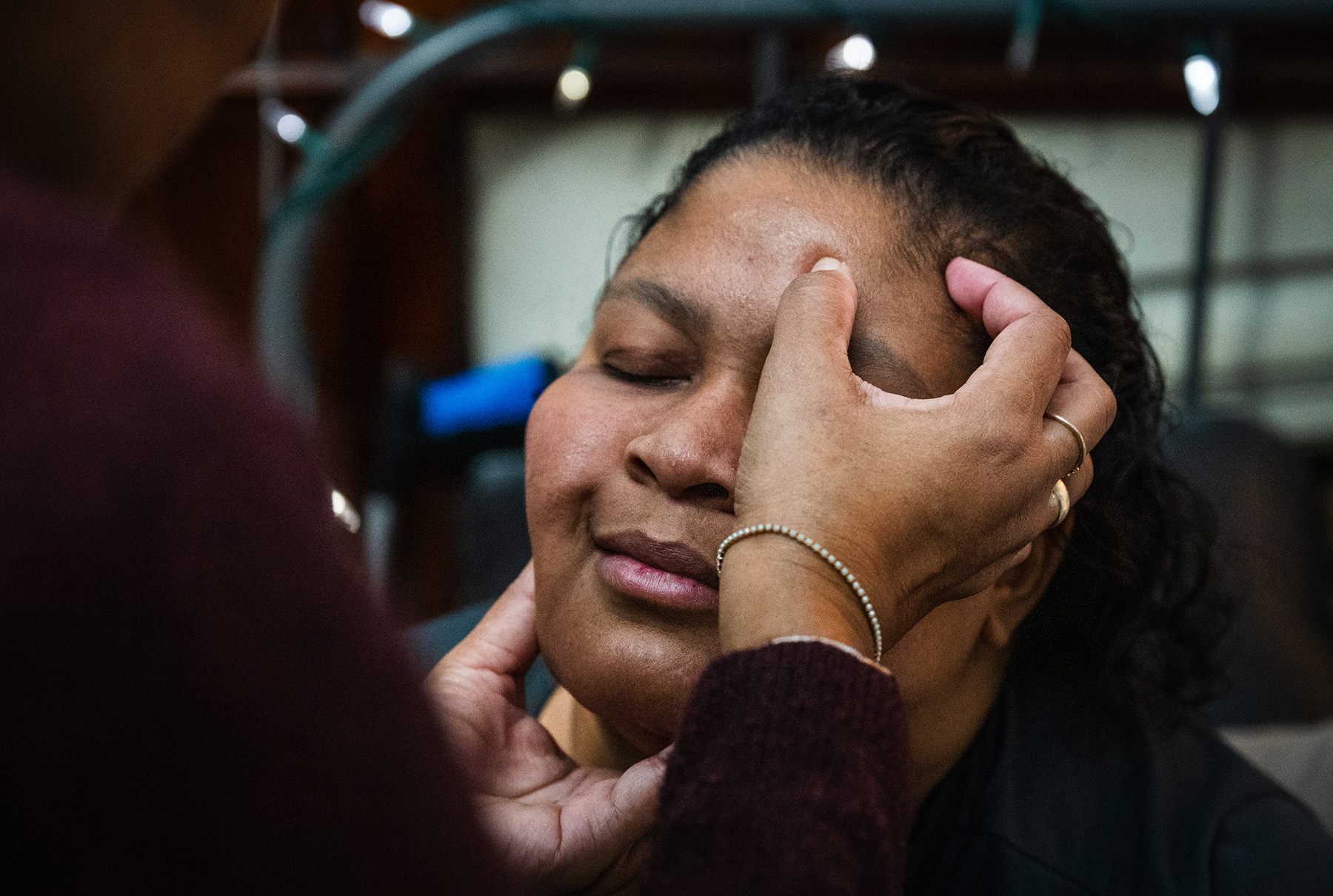
Saving Rhea Seegobin
For the growing number of Canadians who will get cancer in their lifetimes, the financial stress can be profound. But despite her terminal diagnosis, with the support of her community, Rhea is determined to live well.
And How Will You Be Paying for Your Baby Today?
When I first came to the pediatrics unit as an idealistic medical student, I ran into an uncomfortable reality about our universal health-care system.

How Privatized Cataract Surgery Helped Ontario’s Wealthiest—and Left Others Behind
Why a routine surgery offers a window into the possible future of care in this province.
A Clearer Look at the Cost of Care
Dispatches from the edge of the health care system, where money meets medicine and patients are customers.