
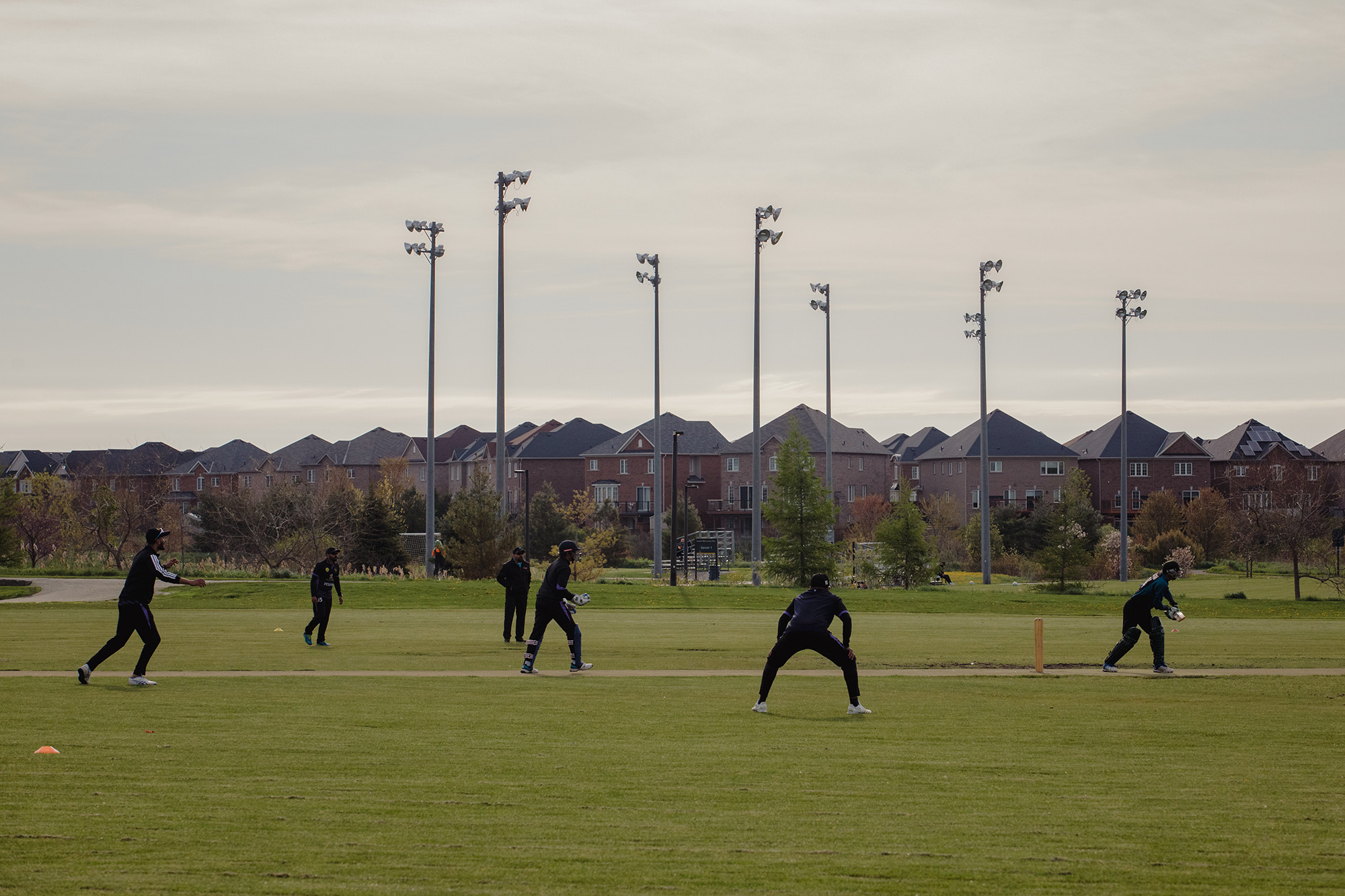
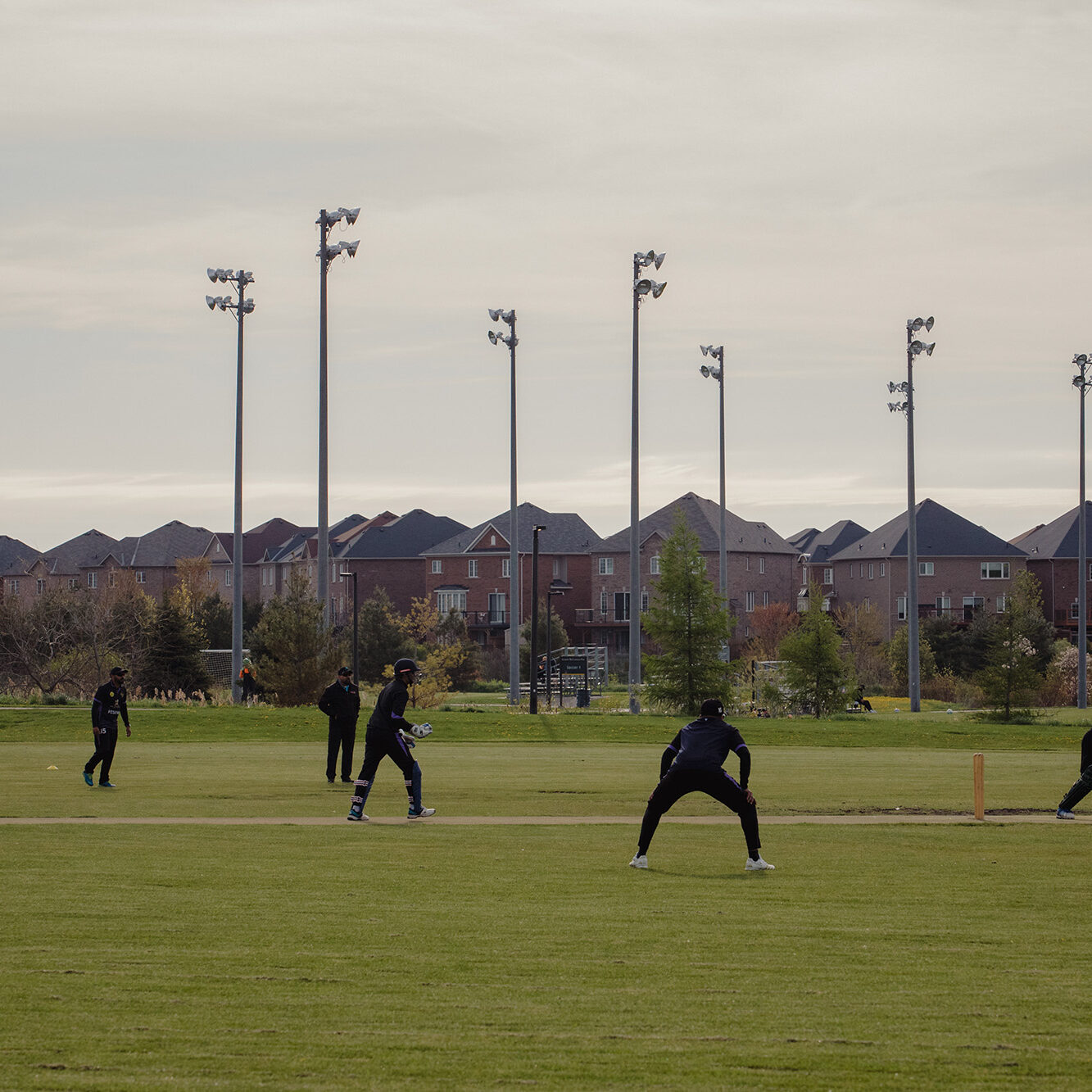
On a Sunday morning in late April, Tausif Shaikh had to get his team into shape.
Thirty-odd cricket players—ranging from their twenties to past their fifties—shuffled into the Manmohan Sports Complex in Brampton for their weekly practice. Carrying athletic bags over their shoulders and Tim Hortons coffee cups in their hands, they walked past flat-screen TVs airing Indian Premier League (IPL) pro matches—inspiration for all the promising juniors practicing across the facility.
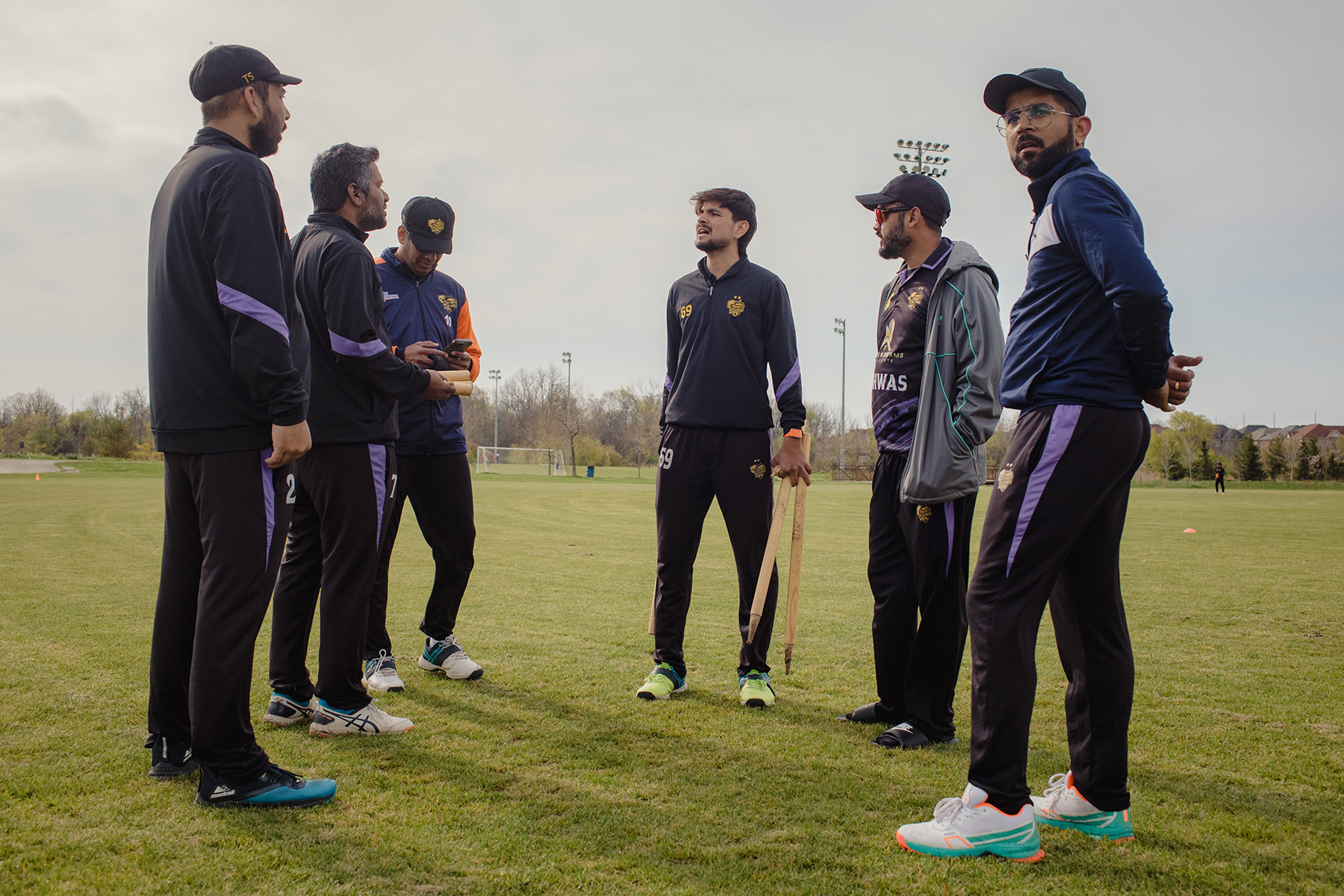
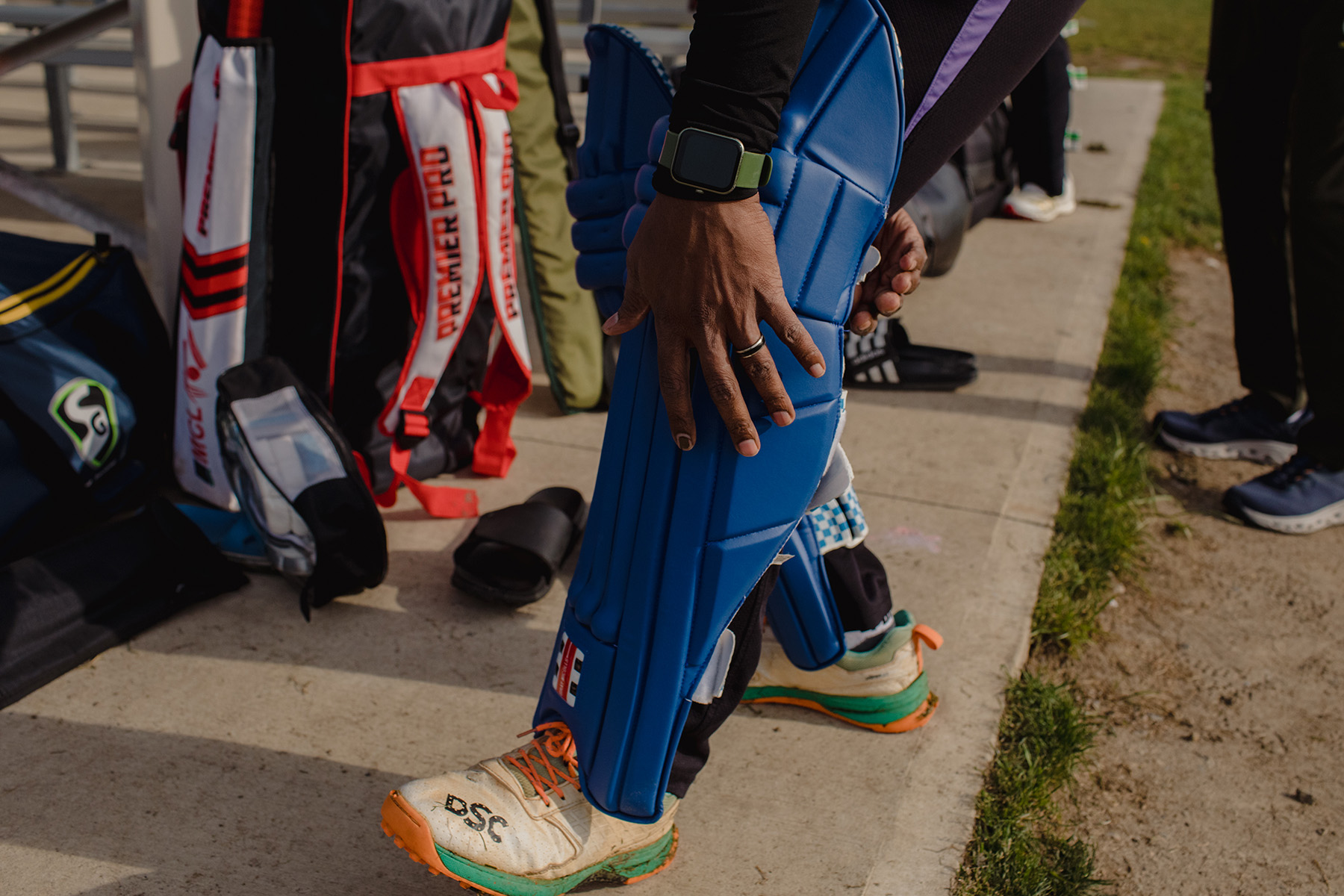
Shaikh led his team, the Toronto Peshwas, to the synthetic turf lanes, where the players strapped on shin guards and gloves and took turns bowling and batting. He guided them from the sidelines, bringing the fast bowlers up first, then the spinners. Pink leather balls came flying off bats with a thwack. Clean hits elicited yells of approval: “shot!” or “shabash! (Hindi for “bravo!”). Eventually, Shaikh twisted around his baseball cap and stepped into the lane himself to show them how it was done.
The Peshwas aren’t professional cricketers, but this is “as professional as a recreational sport can be,” Shaikh told me. Before the heydays of ice hockey or lacrosse, cricket was Canada’s national sport, and over the past decade, with waves of South Asian immigration, it’s become one of the country’s fastest-growing. This has created an entire competitive and business ecosystem across the GTA, with increased public investment, populated by hundreds of teams like the Peshwas.
“I’ve seen it evolve over the past nine years,” Aniket Shinde, a veteran cricket league player, told me at Manmohan Sports that day. He had brought his eight-year-old son to the facility’s Super Kings Academy, a youth training program affiliated with the IPL’s Chennai Super Kings team and billed as a pipeline for local talent. Some of the country’s best cricket players came of age competing in local leagues. This year, Brampton teenager Yuvraj Samra made history at the T20 Cricket World Cup, with a record-breaking performance on Canada’s national team. The GTA has hosted international tournaments and welcomed the sport’s biggest stars.
This made it all the more surprising when Shinde told me that he felt local cricket “is still evolving”—and, in many ways, is “still not the best.”
Even with the increasing number of public grounds for cricket, playing on one casually has perhaps never been more difficult, with prohibitive costs and overwhelming demand from leagues. Private training facilities, seen as promising small business ventures just a few years ago, now face tight margins and heightened competition; as the bubble has popped, many have been forced to close down not long after they opened. Meanwhile, outdoor fields require constant upkeep, and the quality of the pitch varies by municipality. And now, newly reported corruption at cricket’s national level, which includes allegations of gangsterism and match-fixing, threaten the integrity of the sport, and hinder its broader image.
Cricket has come a long way from its elite colonial roots, becoming a more culturally diverse and inclusive sport. The sport’s expanded scale and profit potential could be a boon—rallying Canada’s largest immigrant community, creating new competitive opportunities for youths, and diversifying the country’s athletic identity. But cricket’s popularity hasn’t always translated to a healthy culture within the sport. Indoor facility owners claim they have been shorted the payments they are owed by local team captains, among other financial disputes within the community. One small business owner (who preferred to remain anonymous) told me that, compared to other recreational sports, he doesn’t see a genuine love for the game fuelling the leaders at the grassroots level. “Everybody is just after money,” he said. Is that what a beloved sport is supposed to be?
For as long as cricket has been played in Canada, it has been beset by issues of accessibility. A hallmark of the country’s British colonial history, the sport in Toronto can be traced back to 1827, with the founding of the York Cricket Club. It was originally brought over by English army officers, and later adopted by Upper Canada College schoolboys. It was easy to see the parallels with baseball, the continent’s other large outdoor team sport with batsmen, catchers, and ball-tossers. The British author Goldwin Smith contrasted the two in 1891, observing that cricket in Canada was a time-intensive sport that required a specialized ground—a mowed 22-yard strip called a “pitch”—whereas a baseball game only took two hours to play in a wide-open field. One was a people’s game; the other, patrician.
Despite its status as an elite pastime, cricket would come to represent a crucial stage for emerging nationhood. Canada distinguished itself by winning the first international cricket match against the United States in 1844. By confederation, it was declared the national sport. In 1892, delegates from across the province gathered at the Walker House hotel on Front Street East to form an association “for the encouragement of cricket in the Dominion of Canada.” This is now better known as Cricket Canada, the sport’s national governing body.
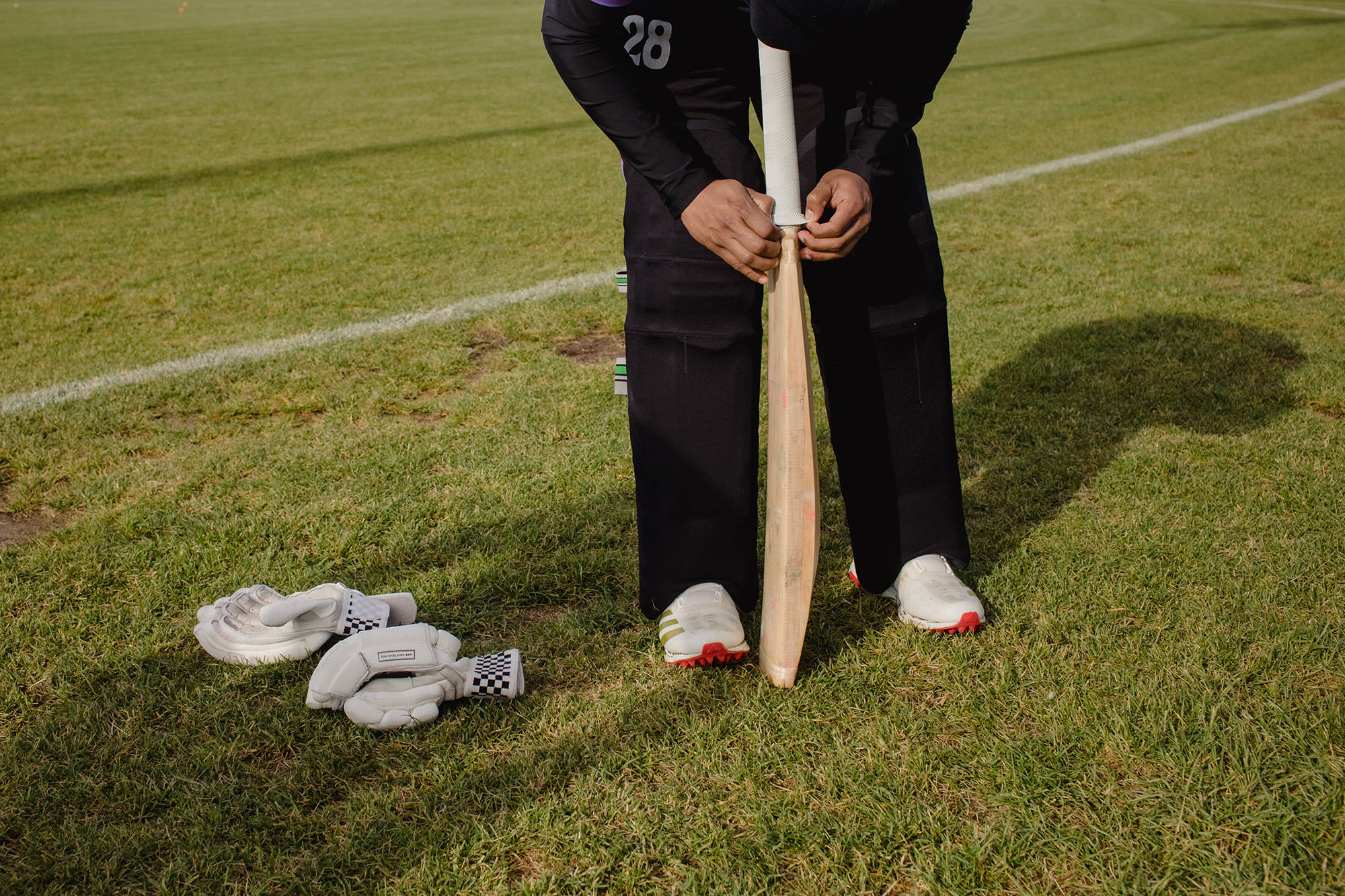
Although cricket wouldn’t remain the country’s official sport, it helped to form Canada’s national identity—much as it would for many other Commonwealth countries. After achieving independence, India, Pakistan, and other nations embraced cricket as part of their cultural fabric. In 20th-century Canada, it largely remained a sport for Laurentian elites. But waves of immigration from South Asian countries led to its grassroots growth.
For my dad and his peers, first-generation Indian immigrants growing up in southern Ontario in the 1970s, cricket was a weekend pastime. The smaller pool of newcomers at the time, and the more niche nature of the sport, led to unique intercommunity connections. As Punjabis from north India, they often played with teammates from a range of other nationalities, including Trinidiadians and Jamaicans.
But the recreational scene evolved over the decades. By 2008, Toronto city councillors described cricket as “the fastest growing sport in Canada,” and recognized the role that immigration played in its growth. Robin Benger, a South African former cricketer and journalist, wrote in 2013 that “Toronto is nirvana for cricket lovers from all points,” with its multicultural landscape a far-cry from the sport’s stuffy Anglo-Saxon origins.
While institutions like the Toronto Cricket Club, or King City’s Maple Leaf Cricket Club, have long served as playing grounds, concerted efforts by surrounding municipalities have led to the creation of new facilities to serve swelling South Asian diaspora communities. Under Patrick Brown’s mayorship, Brampton has touted itself as the “cricket capital of Canada,” with 23 cricket fields across 16 public parks. Toronto currently runs 30 public cricket grounds, and plans to build more.
As a result, the competitive landscape has also grown. Community groups like the Brampton-Etobicoke & District Cricket League (BEDCL) have been around for decades, but new leagues have since emerged in Hamilton, Mississauga, and Brampton. There are now hundreds of teams across the GTA, coming from different regions and diaspora groups of South Asia. Academies and private training facilities have grown in parallel to support playing during the off-season. The inaugural GT20, a nationwide professional cricket competition, was hosted here in 2018. After a hiatus, and under a new American leadership, the event will return this July.
With its explosion in popularity and firm hold on local communities, cricket’s continued growth may seem inevitable—but it’s stymied by structural challenges.
When Tausif Shaikh first moved to Toronto in 2009, he never imagined he’d be leading a cricket team. As with many boys growing up in India, the sport was his first love. But as a graduate student at George Brown College, there weren’t as many opportunities to play.
That is, until he learned about the Marathi Warriors. The team, advertised through Facebook, was little more than a gathering of a dozen or so new arrivals from Mumbai who wanted to play cricket in Brampton. “It started out as just an instinct,” says Shaikh. He didn’t even have a car at the time, but he managed to balance league matches with his school and work schedule, deepening his involvement as the years went on.
In 2016, as the older members phased out, Shaikh took over as team leader. His friend and teammate, Ayyappan Pillai, was deciding whether to stay in Canada or to emigrate elsewhere. “Of all the people on the team, we’ve known each other the longest,” says Shaikh. They were childhood neighbours in Mumbai, and grew up playing cricket together over twenty years before they reconnected in Canada. When Shaikh was looking for a leadership partner, the decision was easy. He and Pillai have since co-captained their team under the new name of the Toronto Peshwas, winning several league championships.
As the team’s membership expanded across the GTA, so did the competitive landscape writ large. Many of the amateur cricketers arriving from India came of age playing in district school teams, and later on, corporate teams run by large employers like Microsoft. Teams like the Peshwas are like mini-enterprises in themselves. They plan annual budgets and manage league registration fees, uniforms, and other expenses, with help from sponsors that include local small businesses.
They have thrived in the competitive field. But increasingly, for many cricketers, it isn’t a level one. In March, the City of Brampton hiked fees across municipal services, including rental permits for cricket grounds, by as much as 160 percent, and introduced additional charges for non-residents. For the Peshwas, a seasonal registration for a single league can now cost up to $400. It’s common for players to compete in multiple league divisions, which could potentially bring the cost upward of $1,200 per person. In a sport that caters to students and newcomers, these increased costs have been felt, and have prompted some broader community pushback.
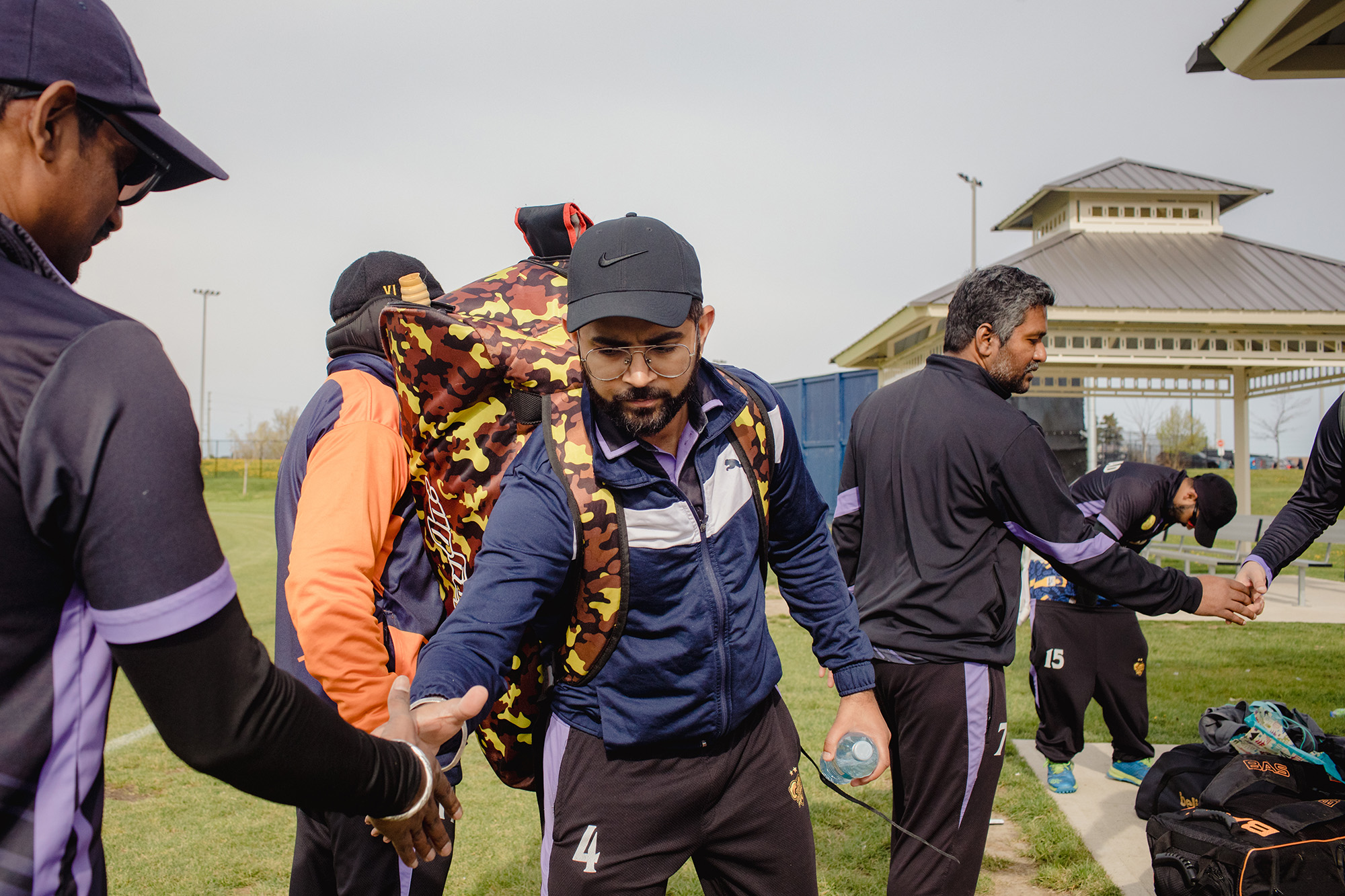
But new teams haven’t been deterred. Large leagues like the BEDCL face long waitlists, and even scheduling an outdoor practice on overbooked cricket grounds can be difficult. Bramptonians have even approached the City Council to propose a draw-based allocation system, allowing more potential access for residents, and limiting the number of teams with non-residents who are arriving from other GTA municipalities.
The limited grounds and long winter months have led to a growing number of private indoor facilities, or “nets,” for teams to train during the off-season. A few years ago, there were only a handful of players in this space. But as more facilities cropped up, the market has become oversaturated, and for owners, the finances are unworkable. It’s led many of these newer facilities to go under. With all these complications, it calls into question how truly accessible cricket can be.
Join the thousands of Torontonians who've signed up for our free newsletter and get award-winning local journalism delivered to your inbox.
"*" indicates required fields

This summer, as the Toronto Peshwas continued their season—their distinctive black kits with regal purple accents popping up on local cricket pitches at dawn and dusk—it wasn’t hard to see the importance of the team for its members. For Anurag Sherkar, who began with the Peshwas as a first-year university student and is now one of the team’s vice-captains, cricket serves as a vital, almost therapeutic space—a plane separate from personal or real-world problems. “For two hours, you just forget what’s going on,” says Sherkar. “Once you step onto the field, you’re in the game.”
Tausif Shaikh says his team is more than just a group of competitors, but a community. “In our WhatsApp group, we’re just a message away from each other,” he says. Teammates have brought their family members to matches, some of them visiting from India, and they’ve enjoyed socializing from the sidelines. That close-knit connection has translated to competitive success. “That’s where it comes together on the field as well, and shows how well you know the person standing next to you,” says Shaikh. He and his co-captain, Ayyappan Pillai, have come a long way from playing cricket together as kids in Mumbai.
This communal connection has fuelled the sport’s growth here, but this alone isn’t enough to sustain it. Pillai welcomes a future where cricket would cease to just be a “brown man’s sport,” but rather an activity with broader appeal. Introducing the sport as part of public school phys-ed curriculums, for instance, could help legitimize cricket, and bring it into the mainstream.
As it stands, the governance of cricket at the grassroots level is fragmented. Without much institutional oversight or regulation, the landscape will remain winners-take-all. At the national level, Cricket Canada has already been penalized following allegations of corruption and financial mismanagement. But a healthy sporting culture begins from the bottom-up. For cricket to continue growing—with new funding, field allocation, and support for everyone—it will require expansion beyond a specific cultural community, where graft or favouritism can occur unchecked.
On a Sunday evening in late June, I watched as the Peshwas arrived at Brampton’s Teramoto Park for their match against the Btown Masters. This year, the team is playing in the BEDCL’s T20 night tournament—a faster, more competitive format reserved for high-caliber teams. Sherkar anticipated this chance to play under the floodlights, “something that you see pro athletes do.”
The Peshwas bowled first, their opponents racking up runs as the match slipped into twilight, and the lights flicked on. Under a gazebo overlooking the grounds, with their parked bags and equipment, the Peshwas roused their bowlers, shouting out encouragements.
I watched Sherkar in the outfield chase down a ball. It flew off the bat into the air, and landed in the outfield—a white dot tumbling across a sea of grass. The ball’s pace slowed as it approached the boundary line, but then it angled slightly away from him. Sherkar sprinted, and reached out for it, but it kept on rolling, just past his grasp.
More from this issue

Where Are All the Female Coaches?
Canada is in a moment of unprecedented expansion in women’s sports. But structural barriers and unclear pathways into coaching mean that women are being deprived of opportunities to lead the next generation of young athletes.

Yasiel Puig at Christie Pits
A free Maple Leafs baseball game at my local playground has long been the best community event in the city. Then the team signed a former Major League Baseball star awaiting sentencing.
Kids Aren’t Active Enough. Youth Sports Are Part of the Problem.
As competitive, specialized athletics dominate gyms and community fields, the children who need physical activity most are the ones being left out.

The Grand Ambitions and Grubby Indignities of the Aspiring Soccer Referee
Making it pro as a referee in Canada is in many ways harder than making it pro as a player. That doesn’t stop this corps of exacting, self-serious officials from trying.

An Illustrated Guide to the FIFA World Cup in Toronto
How many private jets could this pay for? Seven illustrations to make sense of the costs and payoffs of hosting the World Cup.
How Sports Transform a City
The World Cup is a reminder of the massive influence sports can have over a place like Toronto—reshaping our geography, sparking celebration or mourning, and remaking our experience of the city.